

Our fellow Balts in Latvia and Lithuania like to make fun of Estonians by ridiculing us for being slow. Perhaps there’s some truth in it, but this week, at least, Estonia’s politicians proved our Baltic neighbors wrong.
In the space of just a few hours, the parliament showed uncharacteristic unity by electing Ülle Madise as the next president of the country. Meanwhile, Minister of Defense Hanno Pevkur announced his resignation following an embarrassing and costly error in attempting to procure much-needed artillery shells for Ukraine.
Let’s start with the presidential election. Ülle Madise, who is well into her second term as the Chancellor of Justice, was elected in the first round of voting in parliament by receiving 71 votes — surpassing the required 68-vote threshold by three votes.
In the end, four parties backed her as a candidate, meaning she faced no opposition candidates in the process. The only parties not backing her — the populist EKRE and the Center Party — didn’t have enough votes to nominate an alternative candidate.
Such quadripartisan agreement crossing coalition lines is uncommon in Estonian politics. Never before has a first-term president been elected in the first round of voting. It makes one think of all the missed opportunities in national politics.
In truth, Madise was a candidate who would have been difficult to oppose. A constitutional expert with a background in the National Audit Office as well as in former president Toomas Hendrik Ilves’s team, she is scandal-free.
The strongest criticism she faced in the buildup to the election — and one that might especially matter to the readers of this Substack — is her lack of foreign policy experience. Because the president’s role in Estonia is largely ceremonial, apart from holding a pronounced position in diplomacy, having experience in that field is usually the main qualification Estonians look for in a president. We need someone to make Estonia heard on the international stage, someone who makes our presence larger than our geographic size.
Her inexperience in that field was visible during the press conference she gave shortly after her election. When a Finnish reporter asked her about the cooperation she would expect from Estonia’s allies in our current, difficult security situation, she gave a one-sentence response: “I believe that we should continue on the same path and we don’t have to change anything.”
Considering that outgoing president Alar Karis developed a habit of straying from the foreign policy talking points set by the Ministry of Foreign Affairs and the Prime Minister’s Office and sometimes floated “novel ideas”, Madise’s preference to hold the line might not be so bad. What will matter is the team she builds around her. Experience comes with time, and there is no reason to believe she will be a slow learner.
***
While Madise is scandal-free, the controversy surrounding Minister of Defense Hanno Pevkur is growing louder by the hour. Despite being the most popular and trusted minister in the government (which, of course, isn’t saying much given the government’s low overall ratings), Pevkur announced his resignation.
Here is a quick summary of the fast-developing events:
Last week, the National Audit Office reported that the Defense Forces’ inventory records remained so unreliable that auditors could not verify the accuracy of a €1.2 billion inventory balance. This does not mean that €1.2 billion worth of equipment is missing, but it does mean that the state lacks a reliable overview of what it owns, where it is recorded and what condition it is in.
The audit also found problems involving €71.6 million in supplier prepayments. Around €59.8 million of that had gone, in four payments, to Datasel, an Italian-registered company owned by India-based Neco Defense Munitions, under contracts for artillery shells intended for Ukraine. (This was reported in a brilliant investigation by my colleague Madis Hindre in Eesti Ekspress.)
Some components reached an intermediary warehouse, but the state’s defense procurement agency (ECDI) says the delivery was incomplete and of insufficient quality. (Datasel disputes Estonia’s account and claims that it delivered goods worth almost €59 million.) None of the ammunition reached Ukraine.
The invested funds came at least partly from the European Peace Facility. While Estonia and Datasel are now set to battle out their dispute in court, there is a risk that Estonia may need to reimburse the funds back to the EU from its national budget.
The allegations — especially regarding the mishandling of defense inventory — were not new. The Auditor General’s office had made the exact same claim a year earlier. At the time, the Ministry of Defense publicly promised to fix the system. They did not.
Things worsened for the Ministry of Defense when Hindre published his next scoop: the State Prosecutor’s Office had opened a criminal case investigating accounting violations already in October last year. Prosecutor General Astrid Asi stated that investigators also need to determine whether any documents related to the failed artillery shell procurements were “deliberately lost” within the Ministry of Defense.
It has been a grim week for the Estonian defense establishment, and tensions are running high. At a parliamentary special hearing, Auditor General Janar Holm and Commander of the Estonian Defense Forces General Andrus Merilo got into a spat. Merilo insisted that officers shouldn’t be turned into accountants and maintained that nothing had actually been lost.
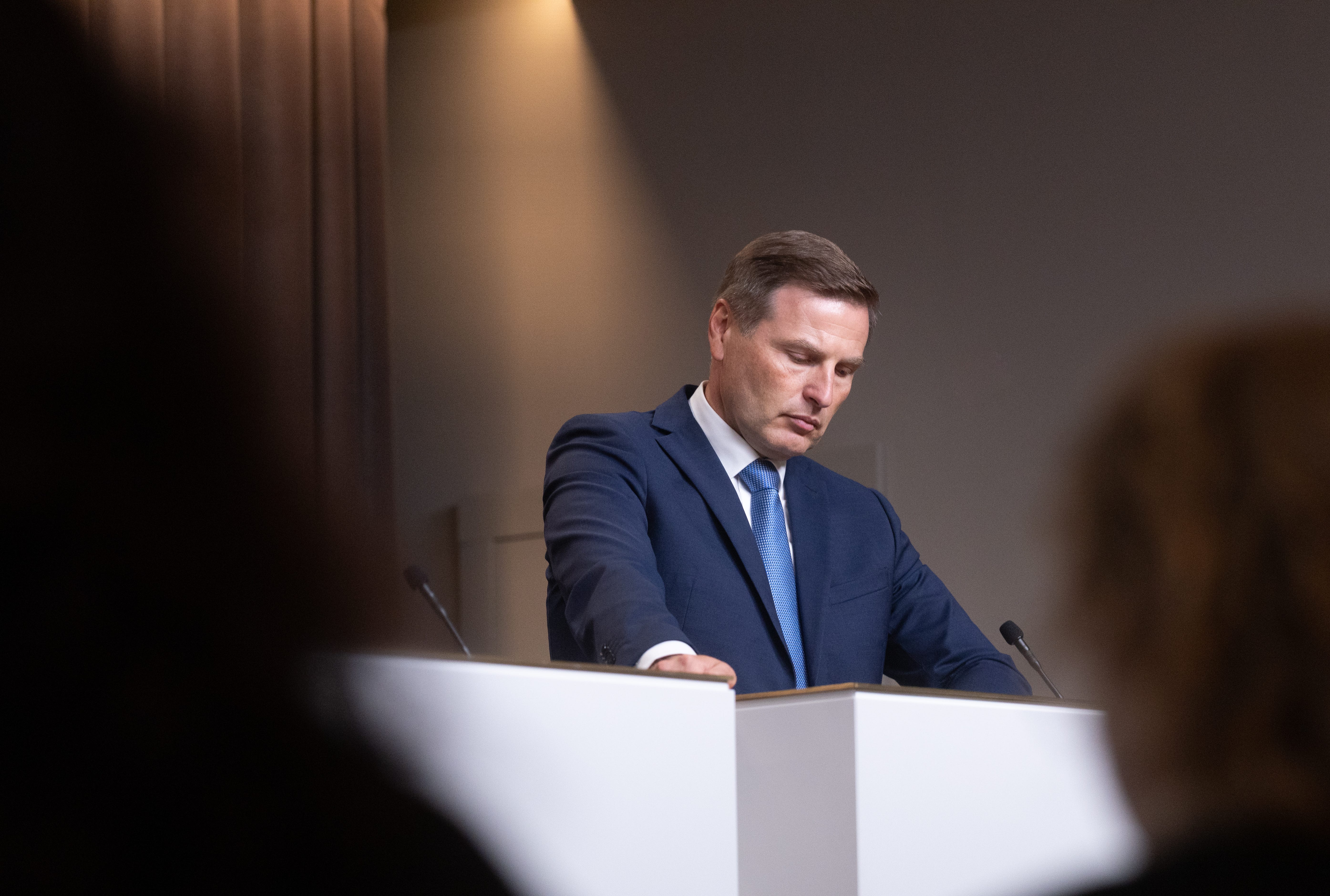
Defense Minister Pevkur’s swift resignation was a logical outcome. First, having been in office since 2022, he bears direct political responsibility. Second, the governing coalition recently lost its parliamentary majority, meaning Pevkur would have faced a difficult no-confidence vote. Finally, with the next parliamentary elections just six months away and Pevkur’s Reform Party polling poorly, the leadership needed to cut its losses. It is not yet clear who will succeed him as defense minister.
With several opposition parties already calling for early elections, a drawn-out and justified public scandal would have only fueled their push to bring down the current government.
What is the moral of the story? Billions of euros are flowing into defense budgets across Europe. It’s a sector that is inherently opaque. Add the pressure of urgency and supply constraints (Europe needs to rearm rapidly, but the defense industry has been unable or unwilling to scale up production fast enough), and you get a volatile mix that invites negligence or corruption. (To be clear, there is currently no evidence of corruption in this specific scandal.)
I highly doubt this will be the last story of its kind we hear from the European defense sector in the coming years.
***
That’s it from me today! Thank you for reading and please feel free to share this post with your friends and colleagues.
Holger